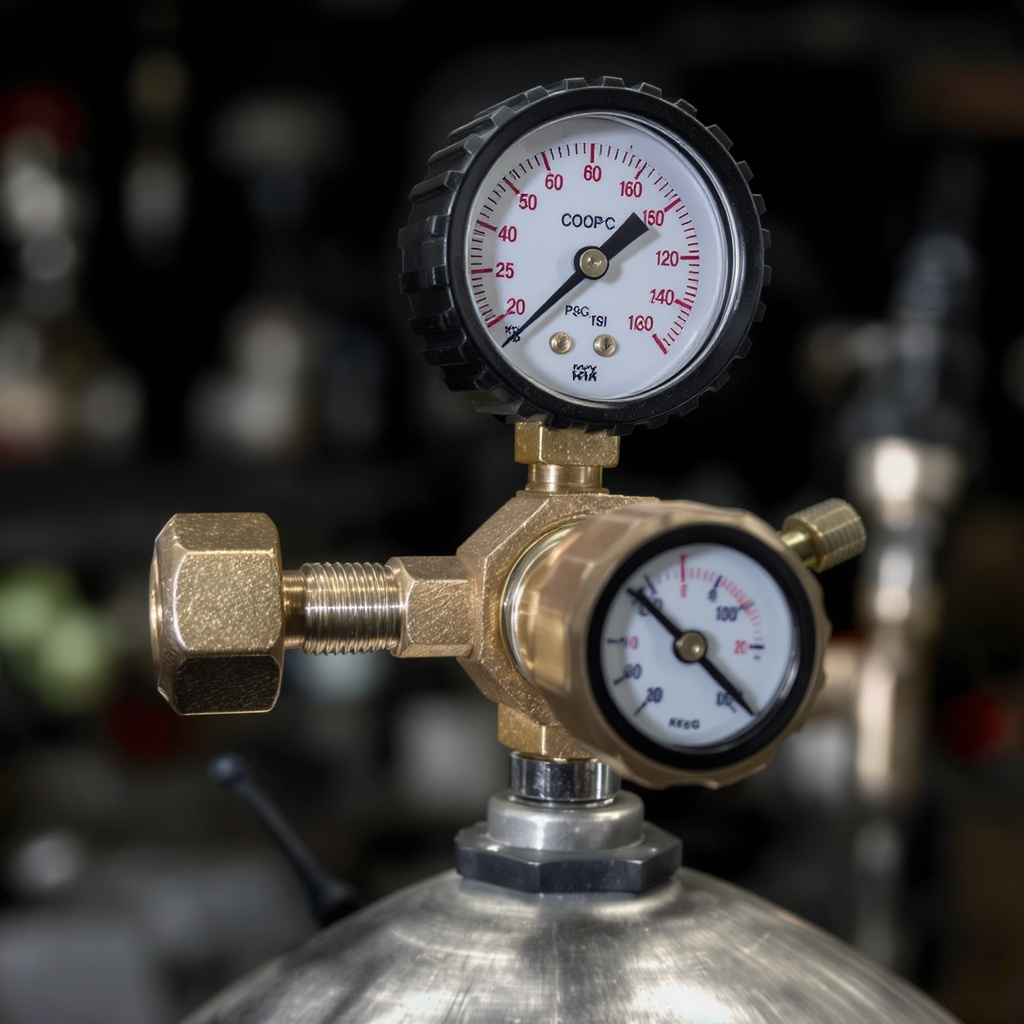
How CO2 Works in a Kegerator
Draft beer is pushed through the line by CO2 pressure — not gravity, not a hand pump. The gas sits above the beer in the keg, and when you open the tap, it forces liquid up and out. Maintain the right pressure, and you get a smooth, carbonated pour. Let pressure drop, and you're drinking flat soda.
Two numbers matter: PSI (the pressure in the gas side) and volumes of CO2 (how much gas is dissolved in the liquid). They work together — you set PSI at the regulator, and the beer temperature determines how much CO2 actually dissolves at that pressure. Cold beer holds more CO2 than warm beer, which is why temperature stability is non-negotiable.
The rule of thumb: at 38°F, 10–12 PSI delivers roughly 2.2–2.5 volumes of CO2 — the sweet spot for most American craft ales and lagers. Raise the temperature and your regulator PSI will need to rise to maintain the same carbonation level.
Keg Coupler Types: D, S, A, and Why It Matters
The coupler is the fitting that connects your CO2/gas line to the keg. Getting this wrong means no pour — it's that simple.
The U.S. market is dominated by the D-system (formally: Sankey D). Nearly every American craft brewery uses it. If you're buying from TapDrop's catalog, you'll use a D-type coupler — it's what the 5-liter mini kegs in our network are built for.
| Coupler Type | Used By | Notes |
|---|---|---|
| D-system (Sankey D) | U.S. craft breweries, Anheuser-Busch, craft imports | Most common for home use |
| S-system | European imports (some German breweries) | Requires dedicated S-coupler |
| A-system | Some imported European brands (Heineken uses a variant) | Verify before purchasing |
| G-system | UK / cask ales | Not applicable for most U.S. home draft setups |
Quick check: If your keg has a threaded inlet at the top and the coupler has matching posts, it's D-type. If you're ordering from TapDrop or any domestic craft supplier, D-type is what you want.
Reading Your Pressure Gauge
A dual-gauge regulator shows two numbers: tank pressure (the cylinder's remaining CO2) and output pressure (the PSI you're sending to the keg). Both matter, but output PSI is what you dial in for serving.
Tank gauge (top number)
This tells you how much CO2 is left in the cylinder. A full 5-pound tank reads around 800–900 PSI at room temperature. As the tank empties, this number drops. When it reads below 100 PSI, you're running on fumes — the output pressure will start to fluctuate and your pours will suffer.
Output gauge (bottom number)
This is the PSI setting that drives your pour. For most ales and lagers at serving temp (38–40°F), 10–12 PSI is the sweet spot. For hop-forward hazies, drop to 8–10 PSI — higher pressure risks stripping delicate aromatics. For stouts and nitrogen-styled beers, bump up to 12–15 PSI.
Choosing the Right CO2 Tank Size
Home kegerators work with tanks from 2.5 pounds (compact, fits under a counter) to 20 pounds (commercial grade, lasts months). Here's the practical breakdown:
| Tank Size | Pours (approx.) | Best For | Refill Cost |
|---|---|---|---|
| 2.5 lb (threaded) | 80–120 pours | Countertop tap systems, light users | $15–25 |
| 5 lb | 150–250 pours | Standard home setup, moderate users | $20–35 |
| 10 lb | 300–500 pours | Heavy users, entertaining regularly | $30–50 |
| 20 lb | 600–1,000 pours | Commercial or very heavy home use | $40–65 |
For most people, a 5-pound tank is the right call: it lasts 2–4 months for typical home use, fits under most countertops, and refill exchange programs are available at any homebrew shop or beverage store.
CO2 Tank Refills: What to Know
Threaded CO2 tanks (the kind that come with most home kegerators and rental units) use a CGA-320 fitting. Any beverage-grade CO2 fill station can handle them — look for homebrew supply shops, beverage distributors, or local welding/gas supply companies.
CO2 is sold by weight, not volume. A 5-pound fill typically costs $20–35 depending on location.交换 exchange programs (swap your empty tank for a full one) run $25–40. Some areas have direct-fill stations that are cheaper; find yours before you run out.
TapDrop renters: CO2 refills are included in your monthly plan. Don't buy a tank exchange if you're a TapDrop subscriber — just schedule a refill through your account and we'll handle it.
Common CO2 Problems and How to Fix Them
Pressure fluctuating (tank reads different each day)
This usually means the tank is near empty — the pressure drops as temperature changes when CO2 is low. If your output PSI has started to drift, refill or replace the tank. It's not a regulator problem; it's a supply problem.
Leaking at the regulator
A hiss from the regulator connection usually means a damaged gasket. Replace the regulator gasket (they're cheap and come in gasket kits). Don't over-tighten the fitting — hand-tight is sufficient.
Pour is flat but gauge reads correctly
Check if the coupler is fully seated — a partially connected coupler leaks gas into the headspace and drinks CO2 faster than it fills the pour. Also verify the temperature: if the beer is above 45°F, CO2 stays in gas form rather than dissolving into the liquid, giving you flat pours even at correct PSI.
Final Notes
CO2 pressure sounds more complicated than it is. Dial in 10–12 PSI, keep the tank full, make sure the coupler matches the keg type, and your system will run without drama. The regulator and couplers are built to be set-and-forget — once it's dialed in, the only maintenance is keeping the tank topped up.
If you want to skip the equipment management entirely, TapDrop's rental plans include everything — the unit, CO2 refills, and maintenance — delivered to your door.
More from TapDrop
Ready to experience great craft beer at home? TapDrop delivers 5-liter mini kegs from top breweries to your door, anywhere in the US.
Browse Mini Kegs →Article last updated: June 2026. CO2 systems and couplers vary by manufacturer and brewery — confirm compatibility before purchasing.